
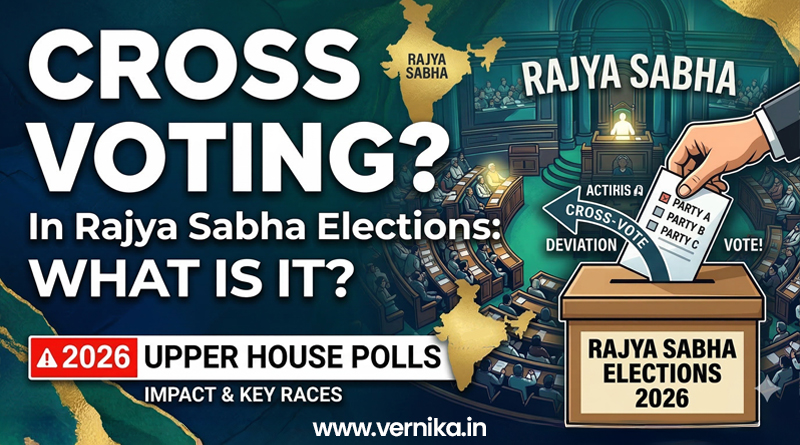
What is cross-voting in Rajya Sabha elections? Impact in the 2026 Upper House Polls
Cross voting is an important issue in Rajya Sabha elections in India. It is a hot-button topic in Indian politics. This phenomenon is also an indication of the behind-the-scenes politics in parties. The recent Rajya Sabha elections in India for the year 2026 witnessed a serious political debate in the context of cross-voting in the elections.
What is cross-voting?
Cross voting is an event in which an MLA votes for a candidate who is not a member of the party to which the MLA belongs. MLAs in state assemblies vote for candidates in Rajya Sabha elections through proportional representation with the Single Transferable Vote System.
Although the party leadership sends a whip to MLAs to vote for the official candidate in the election, sometimes MLAs vote for the rival party candidate. This is a deviation in party politics.
In Rajya Sabha elections, MLAs vote openly. This means they have to disclose their vote to an authorized agent representing their party. Despite this, cross-voting is taking place due to reasons such as factionalism.
The Election Commission of India is in charge of this entire process.
Why Cross Voting Occurs
MLAs engage in cross-voting in Rajya Sabha polls due to a variety of reasons:
- Internal Conflicts within a Party: Sometimes conflicts between party leaders and candidate choice may lead to cross-voting.
- Strategic Moves by Other Parties: Other parties may resort to cross-voting to gain advantage or forge better ties.
- Regional Factors: Sometimes regional factors may prevail over national party decisions.
- Self-Interest or Bargaining Factors: Sometimes personal and bargaining factors may come into play.
- Independent Candidates: In some cases, when an independent candidate joins the fray and receives support from various sides, cross-voting may take place.
Cross Voting in the 2026 Rajya Sabha Elections
There were many such moments in the 2026 Rajya Sabha Elections where cross-voting played a key role, especially in those states where the race is too close to call.
States where cross voting is likely to take place
Uttar Pradesh
As Uttar Pradesh is the state with the maximum Rajya Sabha seats, naturally, there is a lot of focus here. While the BJP is taking a strong stance, other parties such as the Samajwadi Party are trying to assert their power, and even a few cross votes could result in winning one or two seats.
Maharashtra
Coalition politics is always a possibility in Maharashtra, where there are many factions vying to take control, and Rajya Sabha polls here are quite unpredictable.
Karnataka
The contest between the Indian National Congress and the Bharatiya Janata Party is always marred by cross-voting in Rajya Sabha polls, indicating how high-stakes this party rivalry is.
Impact of Cross Voting in 2026 Elections
Cross voting during the 2026 polls had a number of ripple effects.
1) Surprising Results
During the polls, there were situations where candidates, considered to be dark horses, were able to win due to cross-voting.
2) Strains on Party Unity
Cross voting brought to the fore the divide within parties. In a number of states, party leaders decided to probe MLAs accused of cross-voting, taking disciplinary action against them.
3) Helping Rival Alliances
Cross voting gave a boost to rival alliances, helping them win more seats in the Rajya Sabha.
4) Determining Power
Even winning one seat in the Rajya Sabha is significant, as even a few cross votes can determine power.
Legal and Political Consequences
Indian anti-defection laws discourage MLAs from switching parties. However, there is a somewhat complex legal position with regard to Rajya Sabha elections.
As the ballot is not secret, parties can easily identify MLAs who have not followed their party’s line. In such situations, parties have the following options:
- Suspension of MLA
- Expulsion of MLA
- Denial of future tickets
However, anti-defection laws do not apply in the same way as legislative votes.
Historical instances of cross-voting
Cross-voting is not a new concept in Indian politics. There have been many instances of Rajya Sabha polls where there were dramatic turns, where members of opposing parties have shown their support to a particular candidate.
During the previous rounds, there have been unexpected wins in states such as Gujarat, Haryana, and Rajasthan, where MLAs of opposing parties have shown their support for a particular candidate.
Why Cross Voting Matters in National Politics
The Rajya Sabha is not just a supporting actor for the government’s majorities in the Lok Sabha; it is the stage where ideas are converted into law. For a party to convert its ideas into law, it needs a Lok Sabha majority and a strong presence in the Rajya Sabha. Cross-voting thus has its finger on the dial of national politics. Cross voting has the potential to affect:
– Passage of major national legislation
– Constitutional amendment bills
– Policy initiatives and government programs
A party may win a few more seats with the help of cross voting and thus alter the voting pattern.
Conclusion
Cross voting is one of the most interesting aspects of Indian parliamentary democracy. The parties demand strict discipline during the elections, but at times, the lawmakers vote based on their own political calculations. In the 2026 Rajya Sabha elections, the phenomenon of cross voting is an indication of how the final results will be determined. As the Indian political scene is in a state of flux, the phenomenon of cross-voting will continue to play an important role in the Rajya Sabha.