
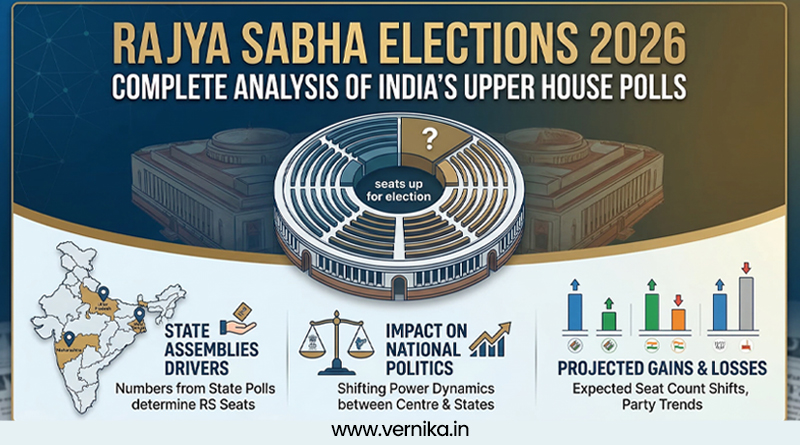
Rajya Sabha Elections 2026: Complete Analysis of India’s Upper House Polls
The Rajya Sabha Elections 2026 have once again grabbed the attention of the nation, which indicates the ever-changing political environment in India. The elections for the Upper House of the Indian Parliament are not direct elections by the people but through the Members of Legislative Assemblies of different states who have already been elected. The elections for the Upper House play an important role in the legislation power of the political parties at the national level.
In the year 2026, the elections for the Upper House are important, as some seats in major states are going to be vacant, as the term for the members in those constituencies is coming to an end after a period of six years.
The Significance of the Rajya Sabha
The Rajya Sabha is the upper house of the Indian Parliament and has a maximum of 250 members. Out of these members, as many as 238 members are elected by the state legislatures and the union territories. On the other hand, the President of India selects 12 members based on their outstanding contribution to the arts, literature, science, and service to society. The members of the Rajya Sabha serve for a period of six years. One-third of the members retire every two years.
Key States in the Rajya Sabha Elections 2026
Some of the major states involved in the Rajya Sabha Elections 2026 include the following:
– Uttar Pradesh
– Bihar
– Maharashtra
– Tamil Nadu
– West Bengal
– Karnataka
– Gujarat
The number of seats allocated to each of these states varies in proportion to their population and the number of representatives they have in the Rajya Sabha. Uttar Pradesh, being the most populous state in the country, sends the largest number of representatives to the Upper House of the Indian Parliament.
Electoral Process
The members of the Rajya Sabha are elected by the Single Transferable Vote system under proportional representation and are administered by the Election Commission of India. In contrast to general elections, MLAs vote in a party fashion, although there have been instances of cross-voting in some cases, resulting in surprises. A candidate must obtain a certain quota of votes based on a formula that considers the total number of MLAs and the number of seats being filled. This system allows for a variety of views to be represented in Parliament and accommodates regional parties that may not have a significant foothold in general elections.
The major players in the upcoming 2026 Rajya Sabha elections are heating up the scene with a high-stakes race between national and regional parties. The major players in this election are as follows:
– Bharatiya Janata Party
– Indian National Congress
– Trinamool Congress
– Samajwadi Party
– Dravida Munnetra Kazhagam
– Biju Janata Dal
– Telugu Desam Party
The ruling party, the BJP, is seeking to increase its Rajya Sabha seats in order to be able to introduce significant reforms without relying on opposition support. On the other hand, the opposition parties are seeking to maintain a strong foothold in order to be able to question and keep the national discourse alive on issues that matter most.
Current Political Context
The BJP-led National Democratic Alliance has managed to increase its strength in the Rajya Sabha over the last ten years, with the regular conduct of elections and the support of regional parties. On the other hand, the opposition coalition, known as the INDIA Alliance, is attempting to secure a majority of votes to prevent the ruling alliance from achieving a majority. For parties whose state legislatures are currently under opposition control, such as Tamil Nadu and West Bengal, the advantage is with the regional parties.
Possibility of Cross Voting and Political Strategy
The possibility of cross voting is an aspect that is always keenly monitored in Rajya Sabha elections. This is because MLAs vote openly in this election. However, politics is not as simple as this. There is competition, divisions, and even switches in alliances. There have been instances in previous elections where some parties have lost in unexpected ways. Some parties lost due to the unexpected rise in support for independents. This is what is likely to be seen in Maharashtra and Karnataka, as they are close contests.
Impact on National Politics
The people occupying the Rajya Sabha seats are the ones who dictate what the government can actually implement. This is because the Lok Sabha may have given the ruling coalition a significant lead, but the Rajya Sabha is not left out.
If the ruling side manages to consolidate its lead in the Rajya Sabha, expect smooth sailing for the following:
– Economic Reforms
– National Security Issues
– Constitutional Reforms
– Social Programs
A strong opposition in the Rajya Sabha also means that debates are expected to be more robust.
Role of Regional Parties
It is the regional parties that have the final say in the elections for the Rajya Sabha. The Biju Janata Dal, the Trinamool Congress, and the Dravida Munnetra Kazhagam are some of the groups that are in a position to hold the balance in the keenly contested elections in the Parliament. The support from these groups can ensure the smooth sailing of the bill or the bill getting stuck in the Upper House. This is a clear example of the federal nature of the country.
Key Trends in 2026 Rajya Sabha Elections
Several trends are being closely monitored by political analysts as the 2026 Rajya Sabha elections are taking place:
– Regional influence on the rise
Regional parties are still holding significant power in the states and thus are expected to feature in the Rajya Sabha as well.
– Strategic selection of candidates
The parties are fielding well-known leaders, economists, and lawyers to strengthen the quality of debates and discussions.
– Coalition formation
The formation of coalitions is also becoming important for the parties.
– Focus on legislative strength
The government and opposition parties are all seeking a lasting grip on the legislative agenda.
Conclusion
The 2026 Rajya Sabha elections are not an election in the run-of-the-mill sense. They are an important landmark that points to the division of power between national and regional forces in Indian politics. As the ground continues to change, the elections will shape what is discussed in the corridors of power, what is decided, and how things are run in the country in the years to come. If the ruling alliance consolidates power further or the opposition gains steam, the elections will leave an indelible mark on Indian parliamentary politics. Given the high stakes and political maneuvering, the 2026 Rajya Sabha elections are likely to shape an important chapter in Indian politics.